How long does the design phase usually take?
The design phase typically takes 6 weeks. This includes drafting floor plans, selecting materials, and finalizing the structural engineering needed before submitting documents to the city.
Learn what drives costs, timelines, and layout decisions when modernizing an aging home on the Palos Verdes Peninsula. Compare finishes and local rules.
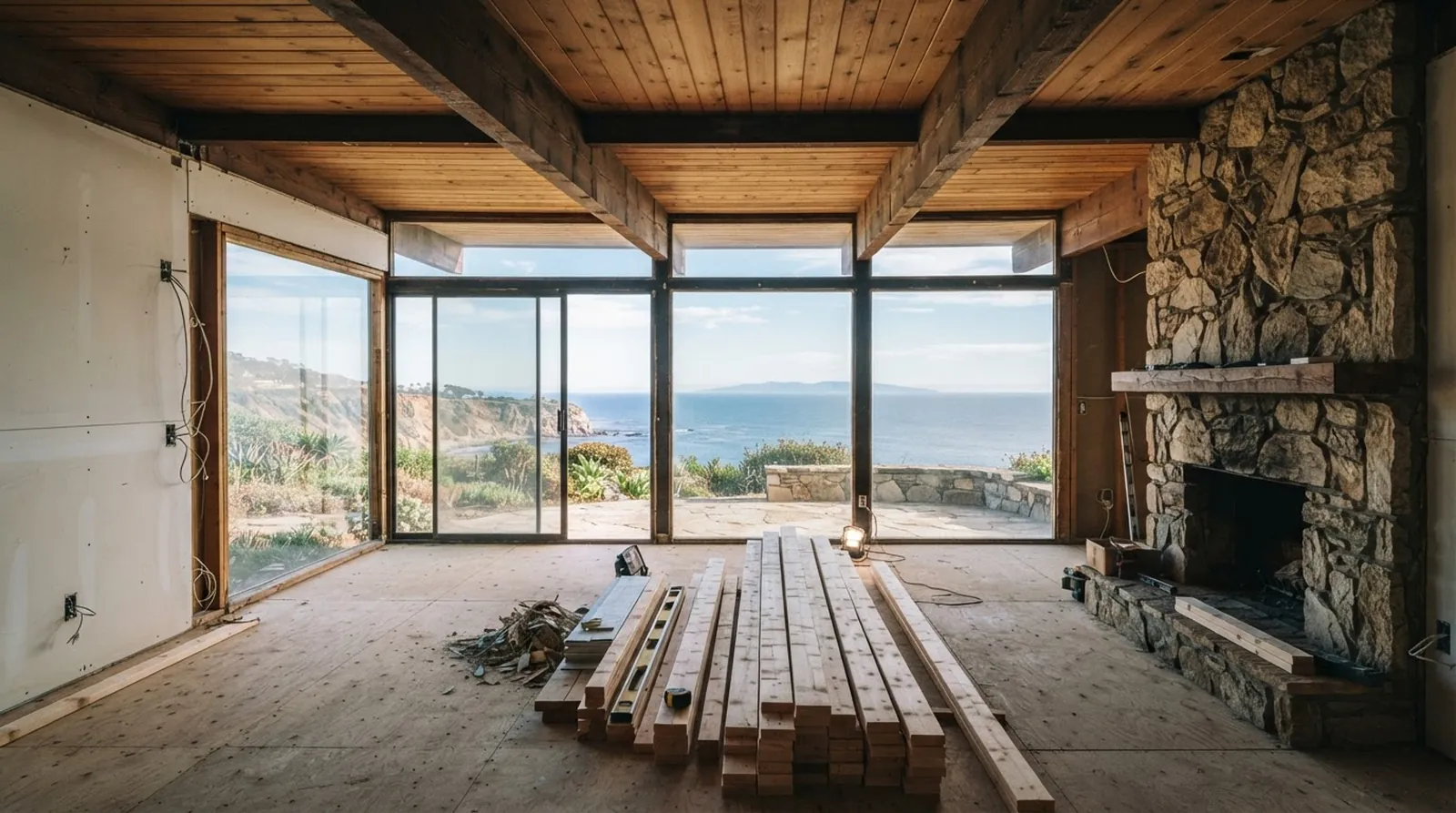
The Palos Verdes Peninsula is full of mid-century and late-twentieth-century homes with great bones and incredible views. But living in a house built decades ago often means dealing with closed-off floor plans, outdated plumbing, and kitchens that feel isolated from the main living areas. Modernizing these properties requires careful planning, especially when dealing with hillside lots, strict local building codes, and neighborhood association rules. Many homeowners find that the layout that worked perfectly in the nineteen-seventies no longer fits how families interact today.
At PV Premier Builders, we match homeowners with contractors to help you navigate this process with no pressure. Understanding the financial and temporal commitment is the first step in turning an aging property into a home that fits your current lifestyle. Remodeling is a major undertaking that disrupts your daily routine for a significant period, so going in with clear expectations about costs and timelines is essential. This guide breaks down what to expect when planning a major update on the Peninsula.
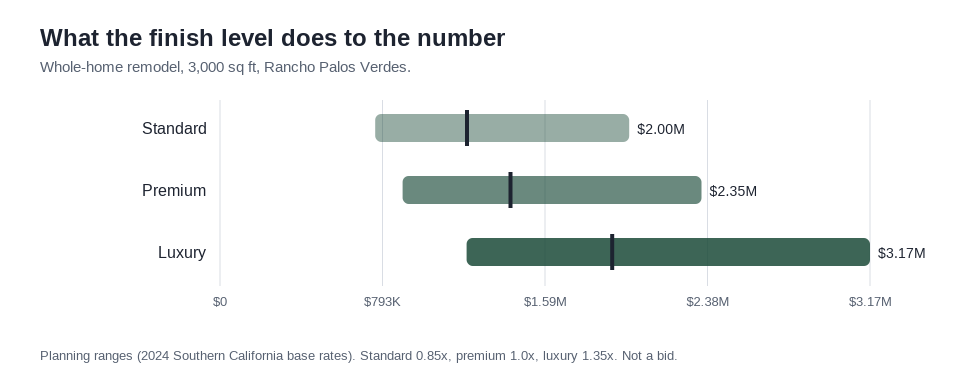
When updating a 3,000 sq ft home, the materials and fixtures you choose play a massive role in the final price tag. A standard finish might mean off-the-shelf cabinetry, durable composite countertops, and cost-effective flooring that still looks great but is mass-produced. Moving up to a premium finish introduces custom millwork, higher-end appliances, and natural stone surfaces that require more care during installation. Luxury finishes push the boundaries with imported materials, fully integrated smart home systems, and highly specialized craftsmanship that demands exact precision.
Looking at Rancho Palos Verdes, a standard finish remodel has a mid-point planning range of $1.20M. If you opt for a premium finish, that mid-point shifts to $1.42M. Taking the project to a luxury level brings the mid-point up to $1.91M. The gap between standard and luxury is substantial, driven entirely by the cost of the raw materials and the specialized, highly trained labor required to install them properly without causing damage.
Contractors price these differences carefully because the margin for error shrinks as the material quality increases. A luxury finish requires more time on site for precise tile alignment, intricate lighting installations, and custom cabinetry fitting. When evaluating contractors, ask how they source materials and whether their typical projects align with the finish level you want. A builder accustomed to standard finishes might struggle to execute a highly detailed luxury design, leading to delays and frustration.
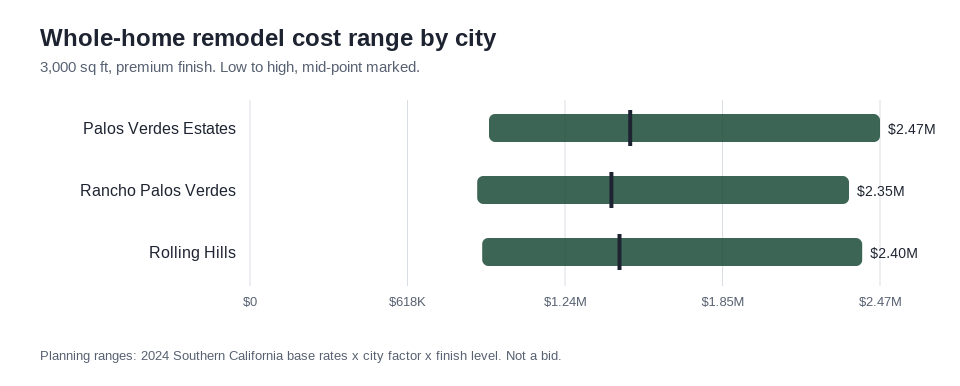
The city you live in on the Peninsula affects your budget just as much as your taste in tile. Each municipality has its own approach to site management, hauling restrictions, and structural requirements. Hillside homes in particular often require extensive soil testing, caisson drilling, and retaining wall updates before any aesthetic work can begin. The logistics of moving earth and materials up and down steep, winding roads add a layer of complexity that flat-lot neighborhoods rarely experience.
For a 3,000 sq ft home with a premium finish, the planning ranges vary noticeably across the hill. In Rancho Palos Verdes, the low end of the range sits at $891K. Move over to Palos Verdes Estates, and that same low end starts at $937K. The difference often comes down to the logistics of getting heavy equipment onto narrow streets and adhering to specific local ordinances regarding construction staging, daily work hours, and street parking for trade workers.
When comparing contractors, it is vital to find someone who understands the specific constraints of your city. A contractor who mostly works on flat lots in other areas might underestimate the cost of hauling debris down a steep driveway or the time it takes to navigate local traffic restrictions. We match homeowners with contractors who have direct experience navigating the distinct logistical challenges of each Peninsula neighborhood, ensuring that your planning ranges are realistic from the start.
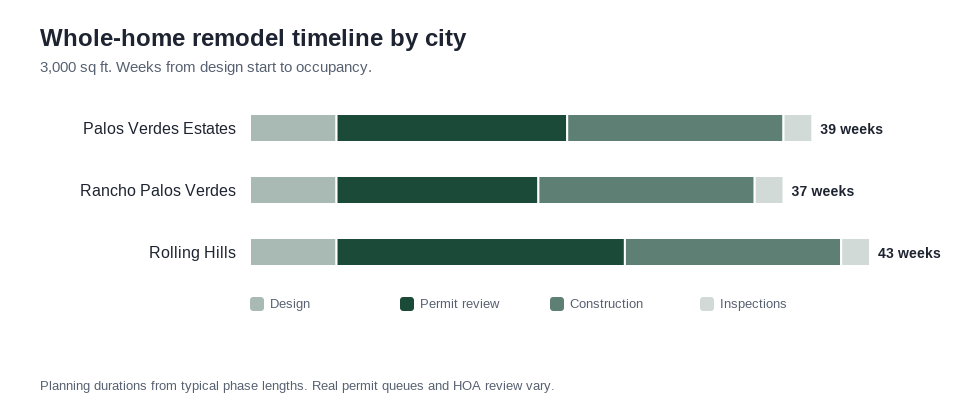
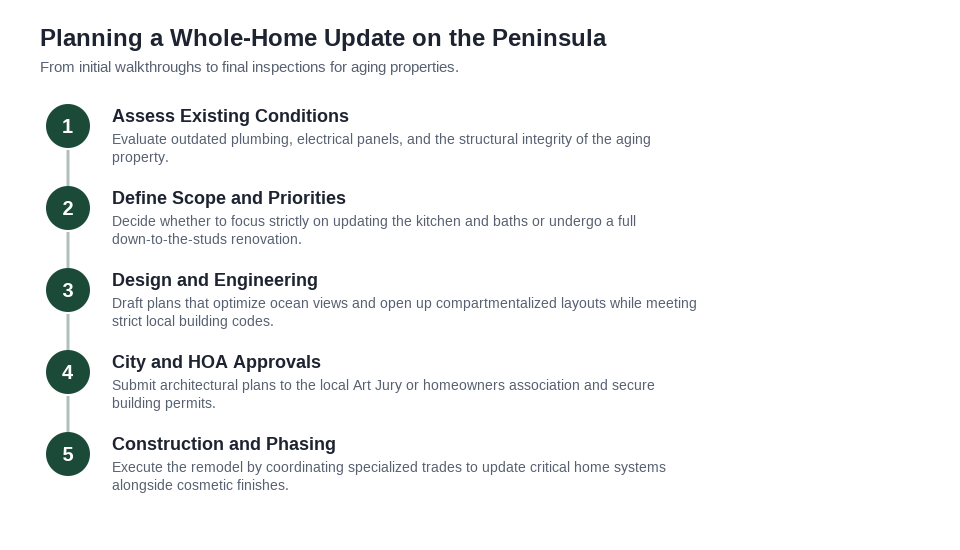
Remodeling an older home is an exercise in patience. Before a hammer ever swings, you have to get through design and permit review. The design phase involves drafting floor plans, selecting materials, and finalizing structural engineering. Once the plans are submitted to the city, the permit review process begins, and this is where timelines diverge based on your address. City planners must review your proposed changes to ensure they comply with zoning laws, height restrictions, and safety codes.
For a 3,000 sq ft project, the permit review phase can take 14 weeks in Rancho Palos Verdes. In Palos Verdes Estates, expect that same review to take 16 weeks. In Rolling Hills, the permit review stretches to 20 weeks. These variations reflect the different layers of design review boards, neighborhood associations, and geological assessments required by each municipality. Some cities require physical story poles to be erected so neighbors can see the proposed roofline changes before approval is granted.
Understanding these timelines helps you plan your living arrangements and financing. You will need to account for a long period of administrative waiting before the physical transformation begins. A contractor familiar with your specific city hall can sometimes anticipate reviewer questions, ensuring your application is complete on the first submission and avoiding unnecessary delays. Knowing the local bureaucracy is just as important as knowing how to frame a wall.
Once permits are in hand, the physical work begins. Modernizing an older home usually starts with demolition, stripping the interior down to the studs to expose aging plumbing and electrical systems. This is the moment when hidden issues, like dry rot, termite damage, or outdated wiring, are discovered and addressed. Upgrading these core systems is crucial for safety and efficiency, ensuring your newly remodeled home functions as well as it looks.
Regardless of whether you are in Rolling Hills or Palos Verdes Estates, the active construction phase for a major remodel typically takes about 15 weeks. This covers everything from framing new walls to installing drywall, laying floors, and fitting cabinetry. The sequence of work is highly coordinated, with plumbers, electricians, and HVAC technicians coming in for rough-in work before the drywall goes up, and returning later for the final fixture installations.
After construction wraps up, you enter the final inspections phase, which generally takes 2 weeks. City inspectors walk the property to confirm that all work matches the approved plans and meets current building codes. They check everything from the electrical panel load to the slope of the shower pan. Only after they sign off can you move furniture back in, hang your artwork, and start enjoying your updated home.
Many older homes on the Peninsula feature compartmentalized layouts, with formal dining rooms, enclosed kitchens, and long hallways. Today, most families prefer an open concept that connects the kitchen to the main living spaces, maximizing natural light and taking full advantage of ocean or canyon views. Achieving this modern flow often involves removing interior walls to create large, multi-purpose gathering spaces that suit casual entertaining and daily family life.
Taking down a wall is rarely as simple as just knocking it over. If the wall is load-bearing, your contractor will need to install a structural beam to support the roof or second story. This requires engineering calculations, specific beam sizing, and city approval. Even non-load-bearing walls can hide plumbing vents, electrical conduits, or HVAC ducts that must be carefully rerouted through the floor or ceiling before the space can be opened up.
When interviewing contractors, ask how they handle structural modifications in older homes. A knowledgeable builder will bring in a structural engineer early in the planning phase to determine exactly what is possible and what it will cost. This proactive approach prevents surprises during demolition and keeps your project moving forward without sudden redesigns. It also ensures that the new open space feels intentional and structurally sound.
Homes built several decades ago were not designed to handle the electrical loads of modern living. Between smart home systems, electric vehicle chargers, and high-end kitchen appliances, your home requires a significant amount of power. Upgrading the main electrical panel is almost always a necessity during a whole-home remodel. This often involves working with the local utility company to bring a larger service line to the house, which requires coordination and advance planning.
Plumbing in older Peninsula homes also presents challenges. Original cast iron drain lines and galvanized steel supply pipes are prone to corrosion, leaks, and blockages. During a major remodel, it makes sense to replace these aging pipes with modern materials like copper or PEX. Relocating a kitchen island or adding a new bathroom means trenching into the concrete slab or running new lines through the crawlspace, which adds to the scope of work.
Addressing these invisible systems is just as important as selecting the right countertop. A beautiful new kitchen will quickly lose its appeal if the water pressure is terrible or the lights flicker when the microwave runs. Make sure the contractors you evaluate include comprehensive updates to the electrical and plumbing systems in their planning ranges, rather than treating them as afterthoughts or unexpected change orders.
The mild climate of the Peninsula makes outdoor living a priority for most homeowners. Modernizing an aging property often includes blurring the lines between indoors and out. This might mean replacing standard sliding doors with large, multi-panel glass systems that fold or pocket into the wall, creating a wide opening to a patio or deck. These heavy glass doors require significant structural headers to carry the weight above the opening.
Exterior upgrades also involve updating the facade to improve curb appeal and energy efficiency. Replacing old single-pane windows, updating siding, and installing modern exterior lighting can completely change the character of a house. For homes exposed to coastal winds and salt air, selecting durable, weather-resistant materials is a critical decision. Stucco, natural stone, and composite decking are popular choices that withstand the local microclimates well.
Keep in mind that exterior changes frequently trigger additional scrutiny from local art juries or design review boards. Your contractor should be prepared to provide detailed material samples, color swatches, and architectural renderings to satisfy these neighborhood associations. Proper planning ensures your new exterior blends beautifully with the surrounding community while reflecting your personal style, avoiding costly revisions after work has already begun.
The design phase typically takes 6 weeks. This includes drafting floor plans, selecting materials, and finalizing the structural engineering needed before submitting documents to the city.
Yes. Hillside properties often require complex soil testing, retaining wall updates, and difficult material staging, which increases the overall cost compared to flat lots.
It is generally not recommended. A whole-home remodel involves shutting off water and power, significant dust, and daily construction noise. Most homeowners rent a temporary place nearby.
In Palos Verdes Estates, the total time from design start to occupancy is typically 39 weeks, assuming standard review times and no major delays.
The contractor must correct the issue to meet the building code and then schedule a reinspection. This is why hiring a contractor familiar with local codes is so important.
Answer a few questions and see local matches, with no pressure.